Does your home put you back together again?
Why creating sanctuary at home is good for the soul – and the life you make beyond your front door
We tend to think of sanctuary as somewhere we escape to.
A retreat. A beautiful hotel. A quiet corner of the world where, for a little while, the demands of everyday life fall away.
But what if the place that matters most as sanctuary is the one we return to every day?
And what if creating sanctuary at home isn’t really about interior decoration, having everything tidy, tasteful and in its proper place? What if it is about something much deeper – our relationship with ourselves and the life we make beyond our front door?
These were not actually the questions I set out to explore when I began writing Hearth. In fact, the book I thought I was going to write turned out to be quite a different one.
The book I didn’t know I was writing
All I knew was that I’d signed up for a six-week Writing Sprint with the commitment of showing up online four days a week, for an hour each day, to work on a book.
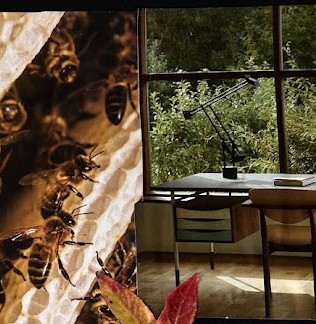
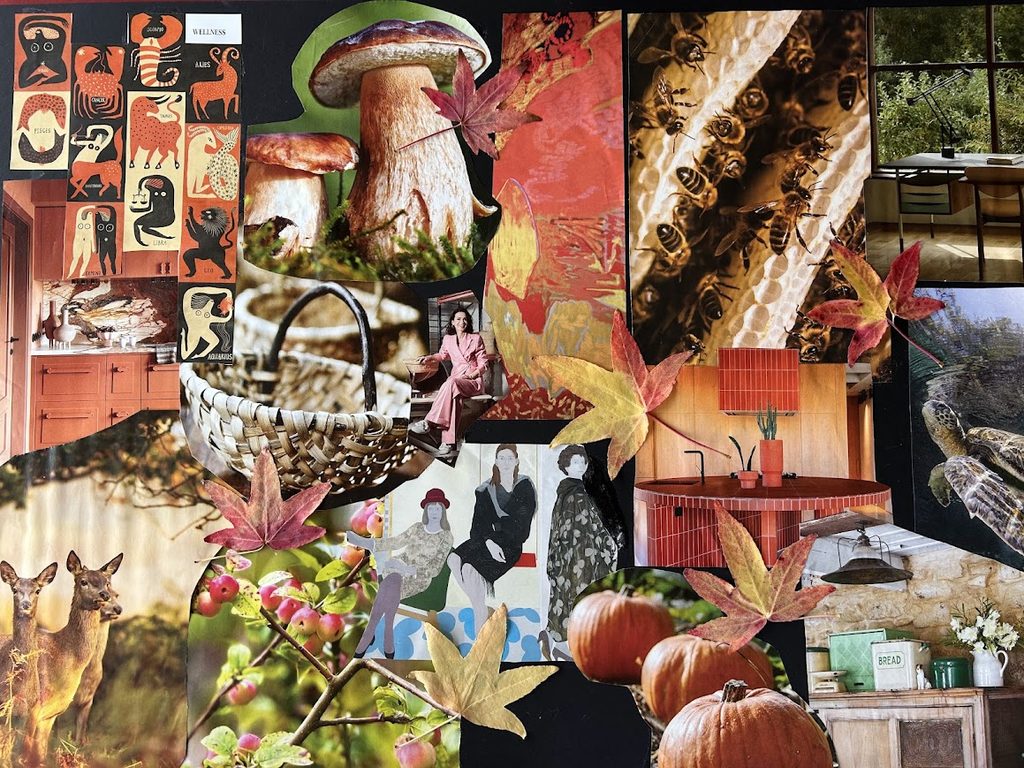
Only the week before the start, I’d made a new Intuitive Vision Board. One image featured a beautiful writing desk, next to a hive of bees, which kind of suggested I might get busy writing something. That something, I thought, was going to be a memoir on a particular theme – and I’d already done a fair amount of preparatory work for it: mountboard covered in Post-it notes, books pulled down from the shelves that inspired me.
But as the start date loomed large, I received a very clear steer:
Not that book just yet, Mary! First share your knowledge about Feng Shui from the past three decades – the work I’d more recently begun describing as Environmental Therapy.
Okay, I’ll just knock that book out first and then get back to writing the memoir, I thought. Who was I kidding!
In my head, I was imagining a book not dissimilar in style to my first book, Awaken Your Intuitive Vision. I’d provide a philosophical introduction to the value of Environmental Therapy, drawing on ancient traditions like Feng Shui and Vastu Shastra, with chapters describing some of the tools and case histories from clients I’d worked with over the years.
My book plan reflected this. Little did I know.
The Sprint started and I started writing. I liked what I was writing – only it didn’t fit the plan. The same thing happened the next day. And the next. Frustrated and confused, it took almost the whole six-week Writing Sprint for me to discover that the book wanting to be written was not a ‘how to’ book, but a ‘why to’ book. That had never crossed my mind before.
It was almost as though the needs of the home – and the spirit of Hestia, goddess of the hearth – were finding a voice through me as I explored questions like:
Why does home matter so much?
Why does the state of our surroundings affect the state of us?
Why might tending our home be one of the most overlooked forms of caring deeply for ourselves?
And then my own body lent a hand with the book
As the Sprint ended, the pain that had begun in my hip three years earlier intensified and, within five weeks, I was having a hip replacement.
Once sufficiently recovered, I signed up for another six-week Writing Sprint and used my convalescence to complete what my fellow sprinters affectionately called a ‘shitty first draft’ – but this time, of the right book.
My editor friend Ann offered to look at the first few chapters to check I was on track and, before long, was doing the same for every chapter as we coaxed Hearth into a recognisable and acceptable shape.
What I still didn’t have was a title that spoke to me. Until I glanced across at my vision board.
There, hiding in plain sight, were no fewer than three hearths that I hadn’t consciously noticed before, while the overall colour wash of the board was decidedly ‘fiery’.
And so the title Hearth popped into my head.
With it came another rather delicious discovery. The chapters could each be formed from words contained within, or created from, the letters of HEARTH:
ET. EARTH. EAT. HEAT. HEART. HEAR. ART.
I began to wonder whose idea it was to write this book!
The place you come home to – and the life you make there
The subtitle is significant too – hey, I consciously chose that one!
Apparently, a good book subtitle should earn its keep as metadata, containing the sort of words people type into search engines. Something along the lines of How to Create a Happy Home would probably have fallen into this category beautifully. Unfortunately, it didn’t speak to me.
But…The Place You Come Home To and the Life You Make There did.
Because that is really what Hearth is all about.
It’s got very little to do with interior decoration. Nor creating the perfect home. Nor applying a stringent set of Feng Shui rules about where to place your bed.
It is about coming home to yourself by striving to become fully at home in the place you call home.
I believe this is where the essence of sanctuary comes into being.
Home as a place of love and safe return.
Coming home as an act of soul retrieval
We spend much of our lives sending our energy outwards.
We go to work. We shop. We care for other people. We negotiate traffic, technology, deadlines, conversations – battling the relentless stimulation of the world beyond our front door.
Not surprisingly, our attention and energy scatter – and parts of ourselves seem to scatter with them too.
Home should be the place where all those pieces can come together again – too late for Humpty Dumpty, I’m afraid.
Returning home can become a daily act of soul retrieval. I love that idea.
However, if you walk through your front door and are immediately confronted by things unfinished, unloved, things you trip over, things belonging to a former version of yourself, possessions you feel guilty about, or simply an atmosphere that makes your heart sink, your home is not helping to put you back together again.
It is asking something more of you in order to be able to give something back. By tending to your home in return, the home tends to you.
This is the reciprocity that lies at the heart of the relationship I explore in Hearth.
I believe we form an energetic relationship with place. When we feel at ease in our surroundings – when they support who we are and correspond to the life we actually want to live – we are as one. We settle.
And life outside the front door has firm ground from which we can move outwards again, with more of ourselves intact.
Sanctuary, then, isn’t about retreating from life. It is about creating the conditions from which we can meet life more fully.
A simple test of sanctuary
Perhaps there is a very simple way to test the sanctuary of your own home.
Next time you cross your threshold, say aloud:
Hello home. It’s good to be back.
Then notice what happens.
Do the words ring true?
Or do you look around and realise that the person – or family – reflected back at you isn’t quite the person or family you know yourselves to be?
If the words fall flat, don’t rush to change anything.
Just notice.
Because that moment of recognition may be your home initiating a conversation with you. The first of many.
A home, like the people who inhabit it, is never finished. It is organic, responsive and forever evolving.
The question is whether your home is evolving with you – or whether it has got left behind.
So where do you begin?
Start by walking through your front door as though you are a visitor to your own home.
What greets you?
Notice the pile you have stopped seeing because it annoys you. The unfinished job your eyes habitually skate past. The object you no longer love but somehow feel obliged to keep. And notice, equally, the things that warm your heart and make you think:
Yes. This is me. This is us. We belong here.
You don’t have to do anything with what you discover immediately. Just be curious.
Environmental Therapy begins when we start listening
Perhaps choose one thing this week that would make your home feel more like a sanctuary – and act upon it.
Move something.
Remove something.
Finish something.
Bring something neglected back to life.
Then notice whether anything shifts inside you too.
Small changes in the home can cause surprisingly large ripples.
And if this way of thinking about home intrigues you, it is precisely the journey I explore in Hearth – The Place You Come Home To and the Life You Make There.
Not how to create the perfect home.
But how to love the home you are already in more – and discover what might change in you when you do.
From my hearth to yours ….
Mary Nondé is an Environmental Therapist, author and creator of the Intuitive Vision Board. Her work explores the relationship between our inner lives and the environments we create around ourselves.